
MindCode
JOURNAL

There are moments,particularly late at night or during periods of silence,when people become aware of something that is almost always present but rarely examined directly: the continuous internal stream of thought that moves through the mind even when no external conversation is taking place.
This internal dialogue can take many forms. Sometimes it appears as verbal self-talk. Sometimes it becomes imagined conversations,replayed memories,future simulations,silent arguments,self-criticism,fantasies,or fragments of unfinished emotional processing that emerge seemingly without invitation.
What makes this experience particularly striking is that the mind often continues generating thoughts even when there is no immediate external problem to solve,no conversation occurring,and no urgent sensory demand requiring attention.
The brain appears unwilling to remain mentally silent for long.
Modern neuroscience suggests that this constant internal activity is not random noise or evidence of mental malfunction,but the product of large-scale neural systems designed to maintain self-referential processing,prediction,memory integration,and future simulation even in the absence of external tasks.
From this perspective,the inner voice is not an interruption of cognition.
It is one of the brain’s default modes of operation.
For many years,neuroscientists assumed that when people were not actively engaged in demanding cognitive tasks,the brain entered a relatively passive or inactive state.
However,brain imaging research revealed something unexpected.
When external task demands decreased,certain brain regions became more active rather than less active,forming what is now known as the Default Mode Network (DMN).
This network includes regions associated with self-referential thinking,autobiographical memory,internal simulation,and reflective cognition.
Instead of shutting down during rest,the brain often redirects attention inward.
When the external world becomes quiet,internal processing intensifies.
The Default Mode Network appears to play a central role in constructing and maintaining the internal narrative of the self.
It becomes active during processes such as remembering the past,imagining the future,evaluating social situations,reflecting on identity,and simulating hypothetical scenarios.
In many ways,the DMN helps maintain psychological continuity across time by linking memories,predictions,emotions,and self-related information into a coherent ongoing narrative.
This may explain why internal thought often revolves around personal concerns,unresolved social interactions,imagined future events,or reinterpretations of past experiences.
The brain continuously updates the story of the self.
Mind-wandering occurs partly because the brain is predictive by nature,constantly attempting to anticipate future possibilities,evaluate unresolved situations,and simulate potential outcomes.
When external attention demands decrease,cognitive resources become available for internally generated processing.
The brain begins moving through memories,predictions,concerns,and hypothetical social scenarios,often without deliberate intention.
This process may have adaptive value.
Simulating future situations allows preparation.
Reviewing past experiences allows learning.
Imagining conversations may help predict social outcomes.
The problem is that systems designed for adaptation can also generate excessive rumination.
One reason socially painful or embarrassing memories return so frequently during quiet moments is that emotionally significant experiences receive enhanced salience within memory systems,particularly when uncertainty or unresolved interpretation remains attached to them.
The brain treats socially threatening experiences as important information because social belonging historically affected survival.
As a result,unresolved social situations may be replayed repeatedly in an attempt to extract lessons,reduce uncertainty,or prepare for future interactions.
The replay feels involuntary because much of the process occurs automatically.
The brain continues analyzing even when conscious intention would prefer to stop.
Imagined conversations are another common form of internally generated cognition.
People frequently simulate arguments,future interactions,explanations,or emotional exchanges inside their minds before or after social encounters occur.
This likely reflects the brain’s attempt to model possible outcomes and refine social predictions.
The simulation may feel unnecessary or exhausting,but from the brain’s perspective,social prediction is important enough to justify continuous rehearsal.
The mind practices interaction internally before reality demands it externally.
Silence often intensifies awareness of internal thought because external sensory input normally competes for attentional resources.
When external stimulation decreases,internally generated cognition becomes more dominant within conscious awareness.
This is one reason intrusive thinking may feel stronger late at night,during isolation,or in quiet environments.
The thoughts were not necessarily absent earlier.
They were competing with external input.
Once the external world quiets down,the internal world becomes easier to hear.
This mechanism can be understood as a dynamic sequence:
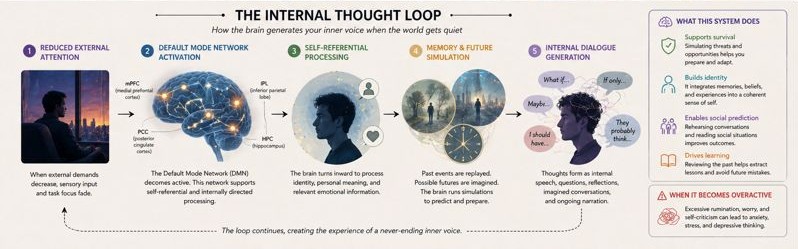
Reduced external attention
→ Default Mode Network activation
→ Self-referential processing
→ Memory and future simulation
→ Internal dialogue generation
Each stage reinforces internally focused cognition,creating the continuous experience of mental narration and reflection.
The internal voice often feels deeply personal because it is constructed from autobiographical memory,emotional learning,social experiences,and self-related prediction systems.
The brain continuously integrates past experiences into present interpretation,generating thoughts that appear connected to identity and personal meaning.
In this sense,the inner voice is partly a reconstruction of accumulated experience interacting with current emotional and cognitive states.
It feels like “you” because it is built from models related to the self.
Although internal simulation and reflective thinking can support planning and adaptation,excessive self-referential processing may contribute to anxiety,rumination,depressive thinking,and chronic stress when the brain becomes trapped in repetitive negative loops.
Under these conditions,prediction systems repeatedly return to unresolved threats or feared future outcomes,reinforcing emotional salience and maintaining cognitive fixation.
The same systems that support reflection can therefore become sources of psychological exhaustion when regulation weakens.
The inner voice persists because the brain was not designed only to react to the external world.
It was also designed to simulate,predict,remember,evaluate,and construct an ongoing model of the self across time.
Even in silence,these systems remain active.
When external demands fade,the mind often turns inward,continuing to generate thoughts,memories,imagined futures,and internal conversations.
The brain keeps speaking because,from its perspective,internal simulation is part of survival itself.
Related reading: The Habit of Replaying Conversations in Your Mind