
MindCode
JOURNAL
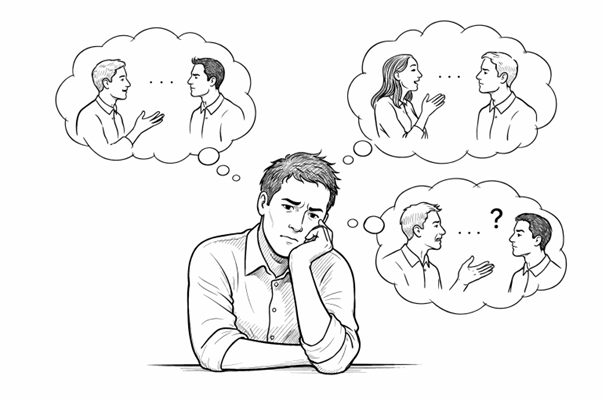
There are conversations that end when they are over.
And then there are conversations that continue—long after you have left the room.
You replay what you said. You reconstruct how it might have sounded. You reconsider pauses, tone, word choice. Small details become disproportionately significant. What felt like a simple interaction at the time becomes something you return to repeatedly, as if there is still something left to resolve.
This process can last minutes, hours, sometimes even days.
It does not feel random. It feels purposeful, as if your mind is trying to understand something important.
But in most cases, what your mind is doing is not actually understanding the conversation.
It is evaluating you within it.
Most conversations are not complete in a strict sense.
They do not produce clear conclusions. They do not confirm exactly how you were perceived. They leave behind a degree of ambiguity—about tone, interpretation, impression.
In many situations, this ambiguity is minor and fades quickly.
But for some people, it does not.
Instead, the mind returns to the interaction, not because the content itself is complex, but because the meaning of the interaction remains unresolved.
What did that response imply?
Did that pause mean something?
Did I come across the way I intended?
These questions are not about the conversation itself. They are about how you were interpreted within it.
And unlike factual questions, these do not have stable answers.
In psychological terms, this pattern is often referred to as post-event processing—a form of repetitive thinking that occurs after social interactions.
It is closely related to rumination, but more specifically tied to social evaluation.
Instead of analyzing what happened in a neutral way, the mind selectively focuses on:
It reconstructs the interaction through a narrow lens, often emphasizing uncertainty and potential error.
Importantly, this process is not passive.
It feels active, analytical, and even necessary.
It creates the impression that you are “figuring something out.”
But unlike productive reflection, it does not move toward resolution.
It cycles.
At a functional level, this pattern is driven by a basic psychological goal:
to reduce uncertainty about social evaluation.
Humans are highly sensitive to how they are perceived by others. Social interactions carry implicit stakes—acceptance, approval, belonging.
When an interaction ends without clear feedback, the mind attempts to fill that gap.
It does this by simulating possibilities.
Maybe they thought I was awkward.
Maybe I said too much.
Maybe I should have responded differently.
Each of these thoughts is an attempt to “complete” the interaction.
The problem is that the variable you are trying to resolve—another person’s internal perception—is not directly accessible.
No amount of internal analysis can fully determine it.
This is why the thinking does not conclude.
One of the reasons this habit persists is that it feels useful.
Each time you revisit the conversation, there is a subtle sense that you are getting closer to clarity. That one more pass through the interaction might reveal the “correct” interpretation.
This creates a loop:
The mind learns that thinking reduces discomfort, even if only briefly.
Over time, this reinforces the habit.
The goal is no longer just understanding—it is maintaining a sense of control over something that is inherently uncertain.
This process is closely tied to self-monitoring.
During conversations, attention is partly directed outward—toward the other person—and partly inward—toward how you are performing within the interaction.
After the conversation ends, the outward component disappears. What remains is the internal evaluation.
Without new input, the mind works with incomplete data. It fills gaps with assumptions, often biased toward negative or uncertain interpretations.
This shifts the experience from interaction to analysis.
You are no longer participating. You are reviewing.
This pattern becomes easier to understand when viewed as a cycle:
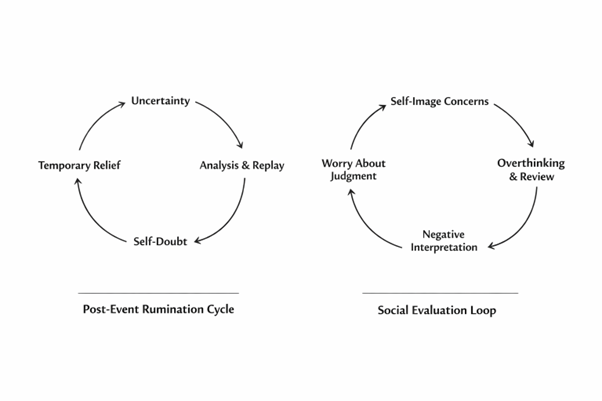
Once you see it as a loop, the experience becomes less confusing.
It is not that the conversation was unusually significant.
It is that the process has no natural endpoint.
Post-event processing is not neutral.
It is biased.
The mind does not replay the entire interaction evenly. It selectively highlights moments that feel uncertain or imperfect.
This bias serves a function.
From an evolutionary perspective, identifying potential social errors may have been useful. It could help adjust behavior and reduce the risk of negative evaluation in future interactions.
However, in modern contexts, this process often becomes excessive.
Instead of improving future behavior, it:
The focus shifts from learning to self-criticism.
At the center of this pattern is an assumption:
That if you think about the interaction long enough, you will eventually arrive at the correct understanding.
But this assumption does not hold.
Social interactions are inherently ambiguous. They involve multiple perspectives, incomplete information, and interpretations that are not directly observable.
Trying to reach certainty through internal analysis is structurally impossible.
The mind continues not because the answer is close—but because the question cannot be fully answered in that way.
Although this pattern is cognitive, its effects extend beyond thinking.
It affects:
Repeatedly replaying conversations can create a sense of mental fatigue without a clear cause.
It can also increase hesitation.
If each interaction is followed by extended analysis, future interactions begin to feel heavier. More is at stake. More needs to be “managed.”
Over time, this can lead to avoidance—not because social interaction is inherently difficult, but because the mental aftermath becomes burdensome.
It may be more accurate to view this habit not as overthinking in general, but as a strategy for managing uncertainty about social perception.
From this perspective, the problem is not that the mind is active.
It is that it is trying to solve a type of problem that does not have a definitive internal solution.
Once this is recognized, the goal shifts.
It is no longer about finding the correct interpretation of the conversation.
It is about recognizing when further thinking is no longer adding value.
The key distinction is not between thinking and not thinking.
It is between:
A useful question to introduce at this point is:
“Is this thought giving me new information, or repeating what I already know?”
If the answer is repetition, the process has shifted from exploration to rumination.
At that point, continuing to think feels active, but it is no longer effective.
Clarity in social interactions does not usually come from extended internal analysis.
It comes from:
In other words, clarity emerges from engagement with reality, not from repeated simulation of it.
This does not eliminate uncertainty completely.
But it reduces the need to resolve it internally.
Replaying conversations is not a sign that something is wrong with you.
It is a pattern your mind uses to deal with uncertainty about how you are perceived.
The difficulty is that this strategy does not scale.
The more it is used, the more it reinforces itself.
What feels like careful thinking gradually becomes a loop.
And the loop continues not because the answer is close—but because the question cannot be answered in the way the mind is trying to answer it.
Recognizing that distinction does not stop the thoughts immediately.
But it changes your relationship to them.
And that is where the pattern begins to loosen.
Related reading: Why You Overthink Everything