
MindCode
JOURNAL

There is a pattern that most people recognize with surprising consistency across very different areas of their lives, yet rarely examine in a precise or structured way, perhaps because it feels too familiar to question: something captures your interest intensely at the beginning, draws your attention almost effortlessly, and creates a sense of engagement that feels natural and even automatic, and then, without any clear external change in the activity itself, that engagement begins to fade, becoming gradually weaker, less stable, and increasingly dependent on conscious effort to maintain.
What makes this experience particularly confusing is not simply the loss of interest, but the apparent lack of a cause that would justify it, because from the outside, nothing significant seems to have changed, and yet internally, the experience is noticeably different. What once felt easy now requires effort, what once felt stimulating now feels neutral or even mildly aversive, and what once pulled you in now feels like something you have to push yourself toward.
It can therefore seem as if interest simply disappears over time, as if it were something fragile or inconsistent.
But from a neuroscientific perspective, this interpretation is incomplete.
Interest is not something you either have or lose.
It is something your brain continuously recalculates.
Dopamine is often described in simplified terms as a “pleasure chemical,” but this description is misleading in a way that obscures its actual role, because dopamine is not primarily responsible for generating pleasure itself, but for signaling the potential for reward, detecting novelty, and directing attention toward what may be worth learning or exploring.
When you encounter something new, especially something that is not fully predictable or immediately understood, dopamine activity increases, not because the experience is inherently pleasurable, but because it carries informational value for the system. The brain treats novelty as a signal that something important may be happening, something that requires attention, learning, or adaptation.
This is why new experiences often feel engaging without effort, and why attention seems to be drawn toward them naturally.
The system is not responding to enjoyment.
It is responding to potential value.
Novelty plays a central role in how interest is generated and maintained, because it creates a gap between expectation and experience, and this gap—often described as prediction error—drives both attention and learning processes.
At the beginning of any new activity, the level of uncertainty is relatively high, and this uncertainty keeps the system engaged, because there is more to discover, more to process, and more to resolve. Each interaction provides new information, and each piece of information contributes to updating the internal model of the activity.
However, novelty is inherently temporary.
As the activity becomes more familiar, the system becomes more efficient at predicting outcomes, the prediction error decreases, and the informational value of each new interaction is reduced. Patterns become recognizable, variability decreases, and the need for sustained attention diminishes accordingly.
In this sense, the activity has not changed.
But its informational structure has.
As familiarity increases, the brain begins to treat the activity differently, not because it has become objectively less important, but because it has become more predictable and therefore less informative.
This leads to a recalibration of perceived value, where the same activity that once generated a strong engagement signal now produces a weaker one, simply because it no longer provides the same level of novelty or learning opportunity.
At the same time, the effort required to continue engaging with the activity does not necessarily decrease in parallel, and in many cases, it may even become more noticeable, particularly when the activity requires sustained attention, repetition, or deliberate practice.
This creates a divergence between reward and effort.
The reward signal decreases as familiarity increases.
The effort signal remains constant or becomes more salient.
And the balance between them shifts.
One of the most important insights from recent neuroscience is that the brain does not passively respond to activities, but actively evaluates them in terms of their expected value, continuously integrating information about reward, effort, novelty, and internal state in order to determine how resources should be allocated.
This evaluation process is not experienced as a conscious calculation, but as a change in subjective experience, particularly in the form of shifting motivation, attention, and interest.
In effect, the brain is constantly asking whether an activity remains worth the energy it requires, and this question is answered not through deliberate reasoning, but through changes in underlying neural signals that influence how the activity feels.
When those signals change, the experience of interest changes with them.
The decline in interest rarely occurs suddenly, but instead unfolds gradually, often beginning with subtle shifts that may not be immediately recognized, such as a slight reduction in focus, a mild increase in distractibility, or a growing sense that the activity requires more effort than it did before.
Over time, these small changes accumulate, and the activity begins to feel less compelling, even if its objective importance has not changed, and even if you still consciously intend to continue it.
What changes is not your explicit goal.
It is the internal signal that supports sustained engagement.
And when that signal weakens, engagement becomes less automatic and more effortful.
At a certain point, a mismatch can develop between the effort required to continue the activity and the reward it appears to provide, and this mismatch plays a central role in the subjective experience of losing interest.
When the perceived reward decreases while the perceived effort remains stable or increases, the activity becomes less attractive to the system, even if it remains valuable in a broader sense.
This is not a failure of discipline or consistency, but a reflection of how the brain prioritizes efficiency in energy allocation.
The system is not designed to maintain engagement indefinitely.
It is designed to distribute effort in a way that maximizes perceived value.
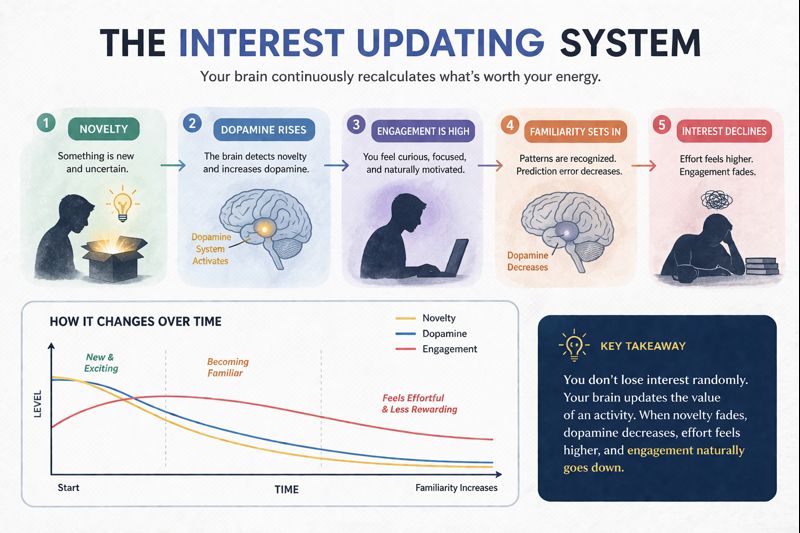
This entire process becomes easier to understand when it is conceptualized as a dynamic system rather than as a fixed trait.
At the beginning, novelty is high, dopamine activity increases, and engagement is naturally sustained, but as familiarity increases, dopamine activity decreases, the effort required becomes more noticeable, and engagement gradually declines as the system updates its evaluation.
This is not a breakdown.
It is an adjustment.
And it reflects the way the brain continuously recalibrates what is worth sustained attention.
One of the reasons this process is often misunderstood is that it is experienced subjectively as a personal change, as if the loss of interest reflects something about your motivation, your discipline, or your ability to stay consistent over time.
But the underlying mechanism is not primarily about personal traits.
It is about dynamic evaluation.
Your brain is updating the perceived value of the activity based on changing conditions, and that update is experienced as a shift in interest.
This does not mean the evaluation is always accurate or optimal.
But it does mean that it follows a systematic process rather than occurring randomly.
Understanding this process changes how motivation is interpreted, because it suggests that motivation is not something that needs to be generated independently of context, but something that emerges from the way the brain evaluates the relationship between effort, reward, and novelty.
When that evaluation shifts, motivation shifts with it.
This does not mean that engagement cannot be maintained, but it does mean that sustaining it requires working with the system rather than against it.
Interest does not disappear without reason.
It reflects a recalculation.
You do not lose interest in things simply because you are inconsistent, undisciplined, or unable to follow through, and the experience of losing interest is not evidence of a failure in motivation in the way it is often interpreted.
What you experience as interest is the result of a continuous process in which your brain evaluates novelty, effort, and reward, and adjusts engagement accordingly based on that evaluation.
When those variables change, the signal that supports engagement changes as well.
And when that signal changes, your experience changes.
Not because you stopped caring.
But because your brain recalculated what is worth your energy.
Related reading: Procrastination Is Not Laziness