
MindCode
JOURNAL
There is a familiar experience that most people recognize immediately, even if they rarely describe it in precise terms.
You know what you need to do, and not in a vague or abstract way, but with a clear understanding of the task, the next step, and often even the consequences of not doing it. The deadline may be approaching, the importance of the task may be obvious, and the intention to act may already be present. And yet, instead of beginning, there is a pause—a moment of hesitation that gradually turns into delay, and then into something more structured, where other activities begin to fill the space that the task was supposed to occupy.
You might check something briefly, reorganize something minor, or engage in something that feels easier to start and easier to complete, even if it is not particularly important. Time passes, often faster than expected, and the task remains exactly where it was, unchanged but increasingly present in the background of your mind.
From an external perspective, this pattern is often reduced to simple explanations such as lack of discipline, poor time management, or even laziness, as if the issue is primarily behavioral and could be corrected by effort alone. But these explanations tend to overlook the internal experience of procrastination, which is not defined by indifference or lack of intention, but by the presence of a specific kind of resistance.
Procrastination is not the absence of motivation.
It is the presence of something that interferes with it.
Procrastination is commonly described as a failure to act, but this description captures only the surface of the behavior and not the process that generates it.
At a more functional level, procrastination can be understood as a form of avoidance, although not in the sense of avoiding the task itself in a purely external way, but rather in the sense of avoiding the internal experience that the task is expected to produce. Every task carries with it a psychological component, and this component varies depending on the nature of the task, the context in which it occurs, and the meaning it holds for the individual.
Some tasks are relatively neutral or even engaging, generating a sense of clarity, direction, or momentum that makes action easier to initiate and sustain. Others, however, are associated with uncertainty, pressure, self-doubt, or the possibility of negative evaluation, and these internal responses change how the task is experienced before it even begins.
When a task is linked to discomfort, the mind does not simply approach it directly. Instead, it begins to evaluate it, often implicitly, through questions that may not be fully articulated but are nevertheless influential: how difficult will this be, what if I do not perform well, what if I get stuck, what does it say about me if I struggle with this?
At that point, the task is no longer just an external requirement.
It becomes something that must be managed internally.
At the center of procrastination lies a relatively simple but powerful dynamic, which is the preference of the mind for short-term emotional relief over long-term benefit, especially in situations where discomfort is immediate and the reward is delayed.
When you avoid a task, even briefly, something changes almost instantly in your internal state. The tension associated with the task decreases, the sense of pressure becomes less intense, and the uncertainty that was previously active fades, at least temporarily. This shift is often subtle enough to go unnoticed, but it is nevertheless significant, because it creates a clear contrast between the state before avoidance and the state after it.
Avoidance feels better, not in a dramatic or explicit way, but in a way that is sufficient for the mind to register it as preferable in that moment.
And because it feels better, even if only briefly, it is reinforced.
The mind learns, through repetition, that not engaging with the task reduces discomfort, and this learning process does not require conscious intention to become established.
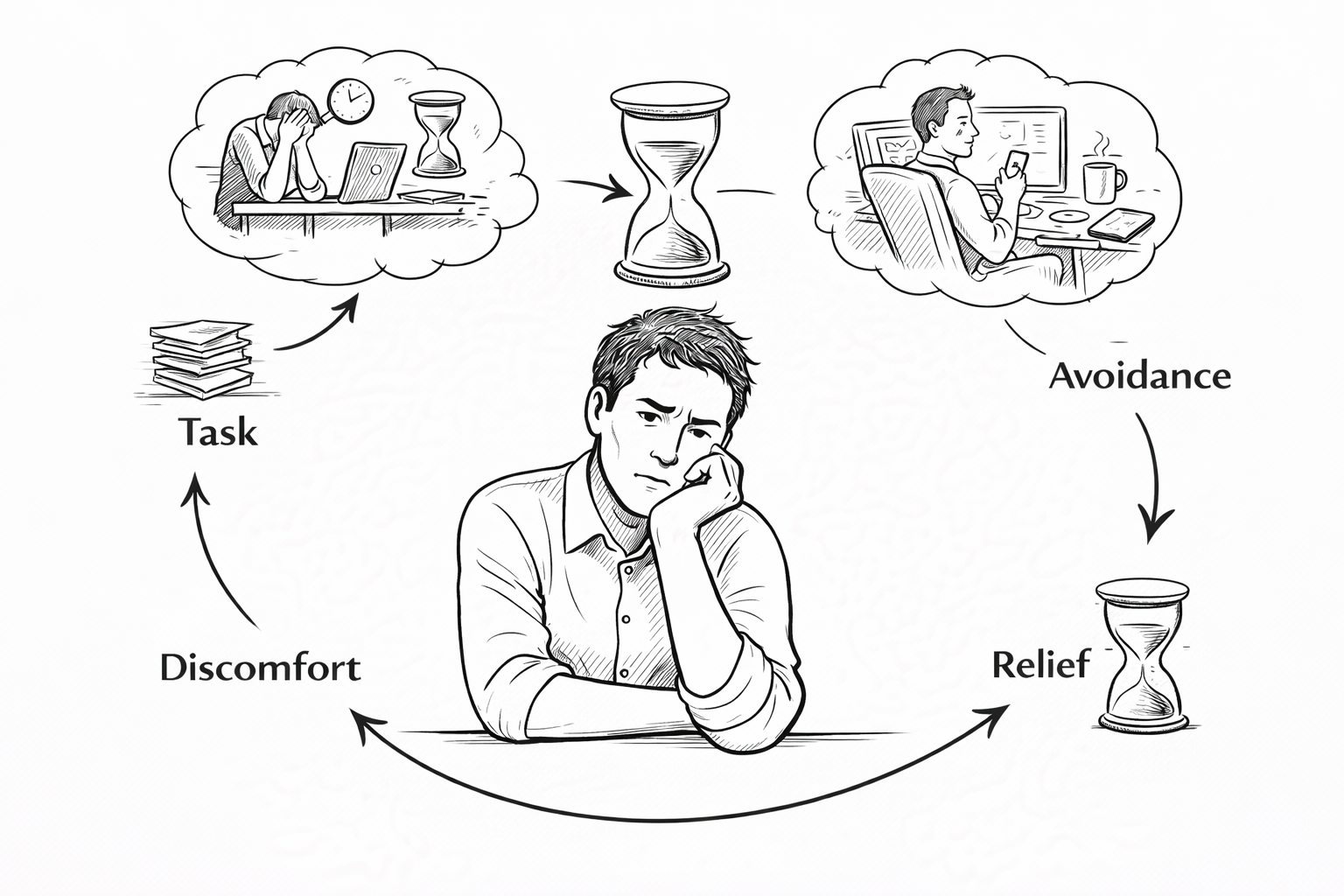
This process becomes easier to understand when it is viewed not as a series of isolated decisions, but as a continuous loop that maintains itself over time.
Once this loop is established, procrastination is no longer dependent on a single moment of hesitation. Instead, it becomes a pattern in which each stage leads predictably to the next, creating a sequence that is difficult to interrupt from within.
The task activates discomfort, the discomfort leads to avoidance, the avoidance produces relief, and the relief reinforces the tendency to avoid in the future. What is important here is that this loop operates largely independently of your explicit intentions, meaning that you can genuinely want to act while still remaining within the pattern that prevents you from doing so.
The experience is not one of choosing not to act.
It is one of being pulled in a direction that feels easier in the moment.
One of the most puzzling aspects of procrastination is the way in which starting a task can feel disproportionately difficult compared to the task itself, even when the task is objectively manageable.
This difficulty is not located in the complexity of the task, but in the initial contact with the internal experience that the task evokes. Before you begin, the task exists primarily as an idea, and ideas have a tendency to expand, to become less defined, and to take on exaggerated significance over time.
The longer the task is avoided, the more space there is for this expansion to occur, and the more the imagined difficulty diverges from the actual requirements of the task. Uncertainty increases, expectations become less clear, and the perceived effort required to begin grows beyond what is realistically necessary.
As a result, the act of starting begins to feel heavier than the process of doing, even though this is not how the task would be experienced if it were already underway.
A common assumption underlying procrastination is that action should follow a certain internal state, such as clarity, confidence, or motivation, and that once this state is achieved, the task will become easier to initiate.
In practice, however, this sequence rarely occurs in the way it is expected.
Readiness is not typically a prerequisite for action, but rather something that develops as a result of engaging with the task itself. Waiting for the internal state to change before acting keeps attention focused on how one feels, rather than on what one does, and this focus can prolong the delay indefinitely.
The discomfort does not disappear simply because it is observed or analyzed.
It persists, and the task remains unstarted.
Procrastination is often closely linked to how individuals evaluate themselves, particularly in situations where performance, competence, or comparison are relevant.
Tasks that carry evaluative weight tend to generate more resistance, not necessarily because they are more difficult in objective terms, but because they are connected to how one sees oneself and how one expects to be judged. The possibility of not performing well introduces a secondary layer of meaning that extends beyond the task itself.
Avoiding the task, in this context, becomes a way of avoiding the possibility of confronting that evaluation.
It protects the current self-image from being challenged, but at the same time, it prevents the opportunity for that self-image to be updated through actual experience.
While avoidance provides short-term relief, it produces long-term consequences that accumulate gradually but significantly over time.
Tasks do not disappear when they are delayed. They remain, often becoming more urgent, more complex, or more emotionally charged as deadlines approach and opportunities for gradual progress are reduced. This accumulation creates a secondary form of discomfort, characterized by guilt, frustration, and a sense of being overwhelmed.
The task is no longer experienced as a single action to be completed, but as something that carries emotional weight and cognitive load.
And paradoxically, this increased weight makes it even more difficult to approach, reinforcing the very pattern that created it.
When confronted with procrastination, it is common to respond by trying to think through the problem more carefully, to plan more effectively, or to analyze the reasons behind the delay.
While these strategies can be useful in moderation, they can also become part of the avoidance pattern when they replace action rather than support it. Thinking about the task creates a sense of engagement, but it does not necessarily change the underlying behavior, especially if the thinking remains abstract and disconnected from actual execution.
In this way, thinking can function as a substitute for action, maintaining the loop while giving the impression that progress is being made.
It may be more accurate to understand procrastination not as a failure of time management or discipline, but as a strategy for regulating emotional discomfort in situations where the task evokes uncertainty, pressure, or self-evaluation.
From this perspective, the behavior becomes more coherent.
It is not that the individual does not know what to do.
It is that the immediate experience of doing it is difficult to tolerate.
The point at which this pattern can begin to change is not necessarily the elimination of discomfort, but the recognition that action does not need to be contingent on its absence.
Instead of waiting for the internal state to shift, it becomes possible to act in its presence, allowing discomfort, hesitation, or doubt to coexist with the behavior rather than preventing it.
A useful question in this context is:
“Am I avoiding the task, or avoiding how the task feels?”
This question redirects attention toward the underlying process and creates a distinction between the external action and the internal experience.
Momentum does not typically emerge from a sudden increase in motivation or clarity.
It emerges from engagement.
Once the task is initiated, even at a minimal level, its nature changes. It becomes more concrete, more defined, and less subject to abstract interpretation. The imagined difficulty is replaced by actual interaction, and this often reduces the uncertainty that contributed to the initial resistance.
As uncertainty decreases, the need to avoid it decreases as well.
Procrastination is not an indication that you do not care about what you are doing.
In many cases, it indicates that the task carries enough significance to generate discomfort, uncertainty, or self-evaluation, all of which influence how the task is approached.
Avoidance offers a form of relief, but it is temporary, and the longer it is used as a strategy, the more it reinforces itself as a default response.
Breaking the pattern does not require perfect discipline or the elimination of discomfort.
It requires recognizing what the behavior is doing, and gradually changing how you respond to the experience that makes avoidance appealing in the first place.
Because in most cases, the task is not what prevents action.
It is the experience surrounding it.
Related reading: The Habit of Replaying Conversations in Your Mind