
MindCode
JOURNAL
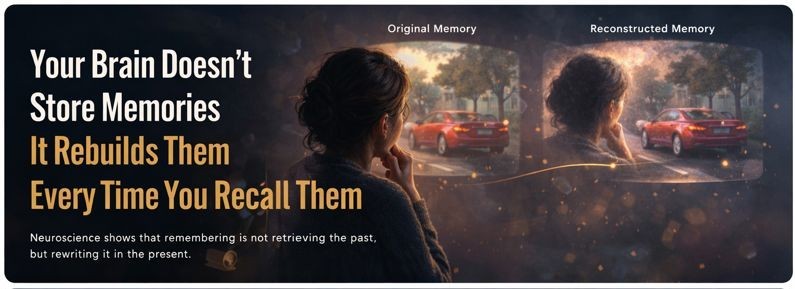
There is a common assumption about memory that feels intuitively correct and rarely gets questioned, largely because it aligns with how memory appears to function subjectively, and that assumption is that memories are stored somewhere in the brain in a relatively stable form, waiting to be accessed when needed, much like files retrieved from a storage system.
However, contemporary neuroscience suggests that this model is not only incomplete, but in many ways fundamentally inaccurate, because memory is not a passive record of past experience that remains unchanged over time, but an active and dynamic process that reconstructs past events each time they are recalled, integrating them with current context, expectations, and internal states.
In other words, you do not simply retrieve a memory.
You rebuild it.
For many years, memory was conceptualized as a three-stage process involving encoding, storage, and retrieval, where information is first encoded during an experience, then stored in a relatively stable form, and finally retrieved when needed, ideally in a way that preserves the original content.
This model has been useful for understanding certain aspects of memory, but it creates the impression that once something is stored, it remains intact, and that recalling it is simply a matter of accessing what is already there.
The problem is that this is not what happens at the neural level.
Retrieval is not a neutral process.
It changes what is retrieved.
When you recall a memory, the brain does not access a complete and fixed representation, but instead reconstructs the event from distributed neural traces, combining fragments of the original experience with current knowledge, beliefs, and contextual cues.
This means that every act of remembering is also an act of interpretation, where the brain fills in gaps, resolves inconsistencies, and updates the memory based on what is currently available.
The reconstructed memory may feel coherent and accurate, but it is not identical to the original experience.
It is a new version of it.
One of the most important discoveries in modern memory research is the process of reconsolidation, which refers to the fact that when a memory is recalled, it becomes temporarily unstable and susceptible to modification before being stored again.
During this window of instability, the memory can be altered, strengthened, weakened, or integrated with new information, after which it is “re-stored” in its updated form.
This means that memory is not only reconstructed during recall, but also rewritten.
And each time this happens, the memory changes, sometimes in subtle ways, sometimes in more significant ones.
Because memories are reconstructed and reconsolidated repeatedly, they are influenced by factors that were not present in the original experience, including current emotional states, beliefs, expectations, and even external suggestions.
Over time, these influences accumulate, leading to gradual shifts in how the memory is represented, which can result in distortions, omissions, or additions that were not part of the original event.
Importantly, these changes are not experienced as distortions.
They are experienced as memory.
And because the reconstructed version feels internally consistent, it is often trusted without question.
One of the most striking aspects of memory is the confidence with which it is experienced, even when it is inaccurate.
This is because the brain prioritizes coherence over precision, meaning that as long as the reconstructed memory forms a coherent narrative, it is accepted as valid, regardless of whether it corresponds exactly to what originally happened.
This creates a disconnect between subjective certainty and objective accuracy, where individuals can feel highly confident about memories that have been significantly altered over time.
Confidence, in this sense, is not a reliable indicator of truth.
It is a reflection of internal consistency.
Every time a memory is recalled, it is filtered through the present moment, meaning that current emotions, beliefs, and knowledge influence how the past is reconstructed.
If your current perspective changes, the way you remember past events may change as well, not because the past itself has changed, but because the framework used to interpret it has.
This is why the same event can be remembered differently at different points in time, depending on the context in which it is recalled.
The memory is not static.
It evolves.
This process can be understood as a dynamic system:
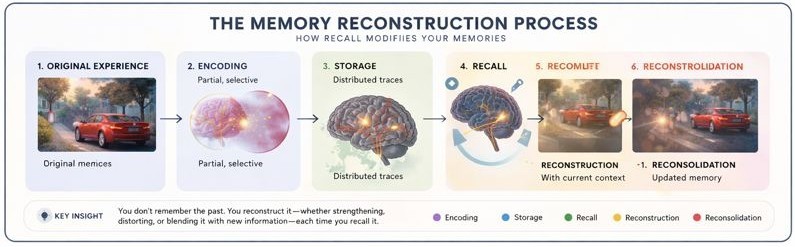
Original experience
→ Encoding (partial, selective)
→ Storage (distributed traces)
→ Recall
→ Reconstruction (with current context)
→ Reconsolidation (updated memory)
Each stage influences the next, and the cycle repeats every time the memory is accessed, gradually shaping its content over time.
What you remember is therefore not a direct copy of the past, but the result of repeated reconstruction.
Understanding memory as a reconstructive process changes how we interpret our own experiences, because it suggests that what we remember is not simply what happened, but what our brain has constructed over time based on both past and present information.
This has implications for how we think about identity, relationships, and personal history, because many of the narratives we rely on are based on memories that have been updated repeatedly, often without our awareness.
It also explains why disagreements about past events can occur even when both individuals are confident in their recollections.
They are not accessing the same memory.
They are reconstructing different versions.
From a functional perspective, the purpose of memory is not to preserve the past perfectly, but to support adaptation in the present, which means that flexibility and the ability to update information may be more valuable than strict accuracy.
A system that can integrate new information into existing memories is better equipped to adjust to changing environments, even if this comes at the cost of precision.
Memory, in this sense, is not a recording device.
It is a predictive and adaptive system.
You do not remember the past in a fixed or unchanging way.
You reconstruct it, and in doing so, you reshape it.
Each time you recall a memory, you are not only accessing it, but also modifying it, integrating it with your current perspective and storing it again in an updated form.
What you experience as memory is therefore not a static record, but a dynamic process.
And over time, that process becomes part of how you understand yourself, not because it preserves the past exactly as it was, but because it continuously redefines it in relation to who you are now.
Related reading: Your Brain Doesn’t Just Predict Rewards