
MindCode
JOURNAL
There is a point in many relationships where something begins to shift—not dramatically, but subtly enough that it can be difficult to name.
At the beginning, interest feels natural and unforced. You are present, attentive, and engaged without having to think about it. Conversations move easily, curiosity comes without effort, and the interaction feels light, even energizing. There is a sense of openness—toward the other person, but also within yourself.
Then, gradually, the context changes.
The connection becomes more consistent. The other person becomes more real, more defined, less abstract. There are expectations now, even if they are not explicitly stated. The interaction starts to carry weight.
And somewhere in that transition, a different experience can emerge.
The same connection that once felt easy can begin to feel unclear, effortful, or even slightly uncomfortable. You may find yourself less responsive, less certain, or less inclined to move things forward. Thoughts become more evaluative. Engagement becomes less automatic.
What often follows is distance.
It may not be intentional or decisive. It can appear gradually—slower replies, less initiative, a subtle pulling back. And when you try to explain it, the most available interpretation is often the simplest one:
“I think I lost interest.”
But in many cases, what is being experienced is not a loss of interest, but a shift in the psychological conditions under which that interest exists.
Early attraction operates within a specific psychological context. It is shaped by uncertainty, novelty, and low emotional risk.
You do not yet know the other person in a stable, detailed way. There is space for interpretation, for projection, for imagining different versions of what the connection could become. This ambiguity is not a problem—it is part of what makes the experience engaging.
At the same time, emotional investment is relatively limited. There is little at stake. The interaction does not yet carry significant consequences.
Because of this, your responses are less constrained. You are not managing expectations. You are not navigating potential loss. You are simply engaging.
As the connection develops, that context changes.
The other person becomes more predictable, but also more significant. The interaction becomes less about possibility and more about participation. There is now something to maintain, something to respond to, something that can be affected by your behavior.
This is the point where attraction begins to intersect with involvement.
And involvement introduces a different set of psychological demands.
As someone gets closer to you, the nature of the interaction changes in a fundamental way.
They are no longer encountering a curated version of you that exists within limited contexts. They begin to see patterns—how you respond, how you think, how you regulate emotion, how consistent you are across situations.
In other words, you become more psychologically visible.
This visibility is not inherently negative, but it increases the salience of evaluation. You are not only engaging with the other person—you are being perceived by them in a more continuous and detailed way.
For many individuals, this activates a form of internal monitoring.
Attention shifts inward:
Behavior can become more controlled. Spontaneity may decrease. Instead of moving naturally within the interaction, there is a subtle effort to manage how one is experienced.
This shift changes the emotional tone. What was previously fluid becomes more effortful. What was implicit becomes more explicit.
Over time, this can contribute to a sense that something is “off,” even if nothing external has changed.
From a psychological standpoint, pulling away at this stage is often not random or purely situational. It can reflect a regulatory response to increased emotional demand.
In attachment terms, this aligns with avoidant attachment activation. When closeness begins to imply dependency, expectation, or emotional responsibility, the system responds by reducing proximity in order to restore equilibrium.
Importantly, this does not require a conscious decision.
It can manifest as:
These are not always signals about the other person. They are often signals about the internal experience of closeness.
Distance, in this context, functions as a regulatory strategy.
This pattern becomes clearer when you see it as a cycle:
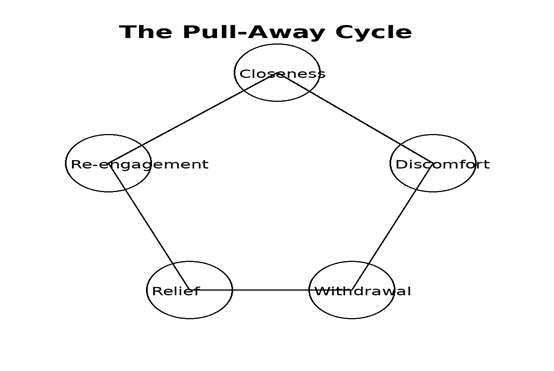
Once you recognize the loop, the behavior stops feeling random and starts becoming predictable.
One of the reasons this pattern is difficult to recognize is that it produces a convincing subjective experience.
When you create distance—whether by disengaging, delaying responses, or reducing contact—the emotional intensity of the interaction decreases. There is less input, fewer demands, and less activation.
This change is often experienced as mental clarity.
The interaction feels simpler. Thoughts become less repetitive. The sense of pressure diminishes.
“I guess I just wasn’t that interested.”
However, what has changed is not necessarily the underlying interest. It is the level of activation associated with it.
Distance regulates the system. It does not resolve it.
Early attraction is highly stimulating. There is novelty, anticipation, and reward in discovering someone new. This phase is strongly associated with dopaminergic reward systems.
As familiarity increases, that level of stimulation naturally declines.
The interaction becomes more stable, but less intense.
If intensity is unconsciously used as a measure of interest, this shift can be misinterpreted.
Stability can feel like absence. Consistency can feel like loss.
There is often an implicit belief that genuine interest should feel easy, clear, and continuous.
When effort or uncertainty appear, they are interpreted as signs that something is wrong.
But as relationships become more meaningful, they also become more complex.
They involve:
This does not indicate incompatibility. It often indicates depth.
This experience is often maintained by recurring patterns:
These are learned tendencies, not deliberate choices.
It may be more accurate to view this not as losing interest, but as encountering a threshold.
A point where the connection moves from low-stakes engagement to meaningful involvement.
At that point, new processes emerge:
If these are uncomfortable, the system reduces intensity.
Withdrawal is not randomness. It is regulation.
Clarity does not always come from stepping back.
It often comes from observing what happens within the interaction.
A more useful question is not:
“Do I feel interested or not?”
But:
“What changes in me when things become more real?”
Pulling away does not automatically mean that something is wrong with the connection.
It often means that something has changed in the level of psychological involvement.
Not every loss of intensity is a loss of interest.
Sometimes, it is the point where something starts to matter.
Related reading: Why You Overthink Everything