
MindCode
JOURNAL
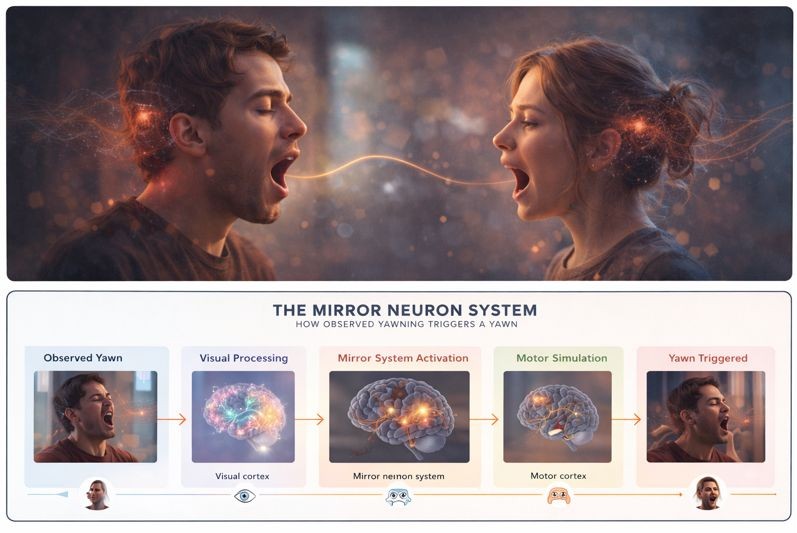
There are few everyday experiences that feel as simple and as strangely universal as the moment when someone nearby yawns and, almost immediately, you feel the urge to do the same, often without any clear awareness of why it is happening or any conscious intention to imitate the behavior.
What makes this phenomenon particularly interesting is not the act of yawning itself, but the way in which it spreads, moving from one person to another in a way that suggests a form of automatic connection between individuals, a connection that operates below the level of deliberate thought and yet has a clear behavioral outcome.
For a long time, this kind of response was treated as a curiosity, something anecdotal rather than something that could be explained in precise neuroscientific terms, but research over the past decades has pointed toward mechanisms that are both more structured and more revealing than they might initially appear.
At the center of this explanation lies a system that is often referred to as the mirror neuron system, and while this system is frequently simplified in popular accounts, its actual function is more nuanced and, in some ways, more interesting.
You do not simply observe what other people do.
Your brain partially recreates it.
Mirror neurons were first identified in the premotor cortex of primates, where researchers observed that certain neurons would fire not only when an individual performed an action, but also when that same individual observed another performing a similar action.
This finding suggested that the brain does not treat perception and action as entirely separate processes, but instead links them through shared neural representations, creating a system in which observing an action activates, to some degree, the same neural patterns involved in performing it.
In humans, this system is thought to involve a network that includes regions such as the inferior frontal gyrus and the inferior parietal lobule, areas associated with action understanding, imitation, and aspects of social cognition.
However, it is important to be precise about what this means.
Mirror neurons do not cause imitation directly.
They create a form of internal simulation.
When you observe someone yawning, the visual information is processed in sensory areas of the brain, but this processing does not remain purely perceptual, because it is rapidly linked to motor representations that correspond to the observed action.
In effect, the brain maps what it sees onto a potential action pattern, activating a representation of the movement as if it were preparing to perform it, even if no overt action is immediately taken.
This activation is typically below the threshold of actual movement, but it creates a state in which the motor system is partially engaged, increasing the likelihood that the action will be executed.
In the case of yawning, this partial activation can be sufficient to trigger the behavior, particularly because yawning itself is a relatively automatic and low-threshold response.
The result is not conscious imitation.
It is facilitated execution.
Contagious yawning appears to depend on a combination of this motor simulation and additional factors related to attention, social connection, and context.
You are more likely to “catch” a yawn when:
· you are paying attention to the other person
· you have some level of social connection with them
· you are in a context where your cognitive control is relaxed
This suggests that the phenomenon is not purely reflexive, but modulated by higher-level processes that influence how strongly the observed action is represented and how likely it is to be translated into behavior.
The mirror system provides the mechanism.
The context determines the strength of the effect.
One of the most robust findings in this area is that contagious yawning is associated with measures of empathy, meaning that individuals who are more sensitive to others’ internal states are also more likely to exhibit this kind of automatic behavioral resonance.
This does not mean that yawning itself is an empathic act, but that the underlying system that supports it overlaps with systems involved in understanding and simulating others’ experiences.
In this sense, contagious yawning can be seen as a minimal form of social attunement, where the boundary between self and other becomes slightly more permeable at the level of neural representation.
You are not just observing the other person.
You are, in a limited way, aligning with them.
Despite its familiarity, contagious yawning is not universal in every situation, and its absence can be just as informative as its presence.
For example, the effect is reduced when attention is diverted, when individuals are less socially engaged, or in certain developmental and clinical conditions where social processing differs from typical patterns.
This variability highlights an important point.
The mirror neuron system is not an isolated reflex.
It operates within a broader network that includes attention, context, and social cognition.
When these elements are altered, the expression of the behavior changes as well.
This mechanism can be understood as a sequence:
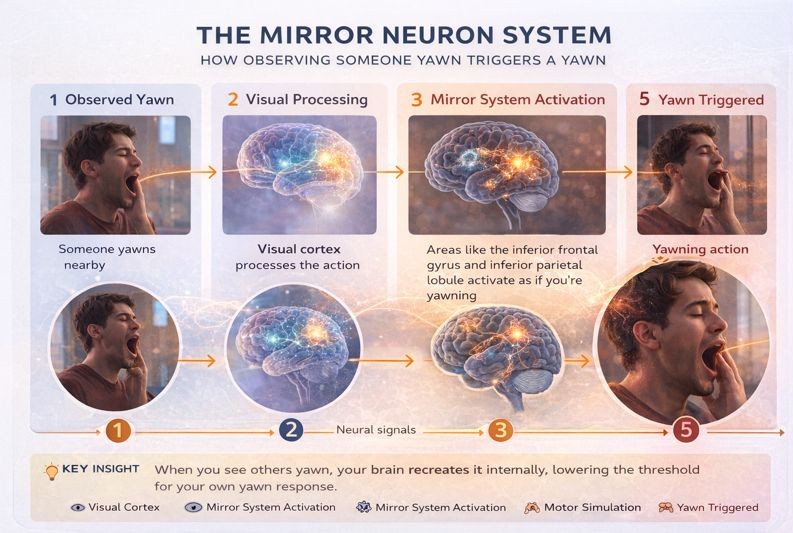
Observed action (yawn)
→ Visual processing
→ Mirror neuron activation
→ Motor simulation
→ Lowered threshold for execution
→ Yawn triggered
Each stage contributes to the next, creating a pathway from perception to action that does not require conscious decision-making.
What appears to be a simple behavioral contagion is, in fact, a structured neural process.
Yawning is only one example of a broader class of phenomena in which observed actions influence behavior through internal simulation.
Similar processes are involved in:
· laughter spreading in groups
· adopting postures or gestures unconsciously
· feeling discomfort when observing someone else in pain
These effects vary in intensity and complexity, but they share a common feature: the brain represents others’ actions and states in a way that partially overlaps with its representation of its own.
This overlap is what allows for rapid social coordination, but also what creates the possibility of behavioral contagion.
It is important to note that while mirror neurons provide a compelling framework, they do not fully explain all aspects of social behavior, and their role has sometimes been overstated in popular accounts.
Contagious yawning, for example, likely involves multiple systems, including attention, arousal regulation, and social cognition, in addition to motor simulation.
This does not reduce the importance of mirror mechanisms.
It places them within a more realistic context.
They are part of the system.
Not the whole explanation.
Contagious yawning is not just a trivial curiosity.
It reveals something fundamental about how the brain links perception and action, and how individuals are connected at a level that operates automatically and often outside of awareness.
You do not simply observe what others do.
Your brain prepares to do it as well.
And in that preparation, even something as simple as a yawn can become shared.