
MindCode
JOURNAL
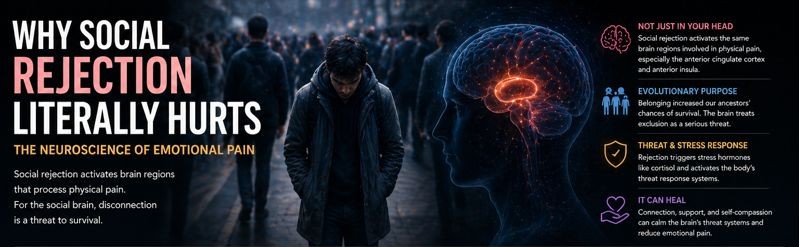
Few human experiences feel as immediately destabilizing as social rejection,particularly because even relatively small moments of exclusion,dismissal,or emotional disconnection can produce reactions that feel disproportionately intense compared to the external event itself,often lingering long after the interaction has ended and continuing to affect thought,mood,attention,and even physical sensation.
What makes this experience especially significant is that people frequently describe rejection using the language of physical injury,saying that they felt “hurt,” “crushed,” “wounded,” or as though they had experienced actual pain rather than a purely emotional reaction.
For a long time,these descriptions were treated as metaphorical expressions rather than reflections of underlying biological reality.
Modern neuroscience,however,suggests that this distinction may be less clear than previously assumed.
Research increasingly shows that social rejection and physical pain partially overlap at the neural level,meaning that experiences of exclusion and emotional loss can activate some of the same brain systems involved in processing bodily injury and threat.
From the brain’s perspective,social pain is not trivial.
It is biologically significant.
Human beings evolved as deeply social organisms whose survival historically depended on group belonging,cooperation,and social protection.
For most of human evolutionary history,exclusion from the group could dramatically reduce the chances of survival,increasing vulnerability to predators,violence,starvation,or isolation from resources.
Because of this,the brain appears to have developed systems that treat social disconnection as a meaningful threat rather than as a minor emotional inconvenience.
In this sense,emotional pain may function as a warning signal designed to protect social bonds in much the same way that physical pain protects the body from injury.
One of the most influential findings in this area emerged from neuroimaging research showing that experiences of social rejection activate regions associated with the affective component of physical pain,particularly the anterior cingulate cortex and the anterior insula.
These regions are involved not simply in detecting physical damage,but in processing the unpleasant emotional quality associated with pain.
This distinction matters because pain is not only a sensory event.
It is also an emotional experience.
And the brain appears to use overlapping systems to process both physical suffering and social distress.
Social rejection threatens more than immediate emotion.
It threatens identity,belonging,predictability,and social security simultaneously,which may explain why even brief experiences of exclusion can produce strong cognitive and emotional reactions.
When rejection occurs,the brain may begin rapidly evaluating social meaning,searching for explanations,predicting future exclusion,and monitoring potential threats to social standing.
This increases emotional salience and attentional fixation,making rejection difficult to ignore once it has occurred.
The event becomes neurologically prioritized.
The intensity of rejection is also influenced by expectation.
Unexpected rejection often produces stronger emotional responses because it generates a larger discrepancy between predicted and actual social outcomes.
In predictive neuroscience frameworks,this creates a form of social prediction error,where the brain must rapidly update its understanding of social safety and interpersonal trust.
The greater the mismatch between expectation and outcome,the stronger the emotional disruption may become.
This is one reason sudden rejection often feels especially painful.
The brain was predicting connection.
Instead,it encountered exclusion.
Unlike many physical injuries that heal through visible biological repair,social pain often persists because the brain continues replaying,analyzing,and reconstructing the socially threatening experience long after it ends.
Memory systems repeatedly reactivate emotionally significant social events,particularly when uncertainty or unresolved interpretation remains.
The brain keeps returning to the experience because it treats the information as important for future social survival.
In this sense,rumination may partly reflect an attempt to reduce future social threat by analyzing past rejection.
Social rejection does not remain confined to abstract emotional experience.
It can influence physiological systems associated with stress regulation,including cortisol release,autonomic nervous system activation,and inflammatory responses.
This helps explain why severe or chronic social isolation is associated with broader health consequences affecting sleep,immune function,and psychological well-being.
The brain interprets prolonged social disconnection as biologically significant stress.
This mechanism can be understood as a dynamic sequence:
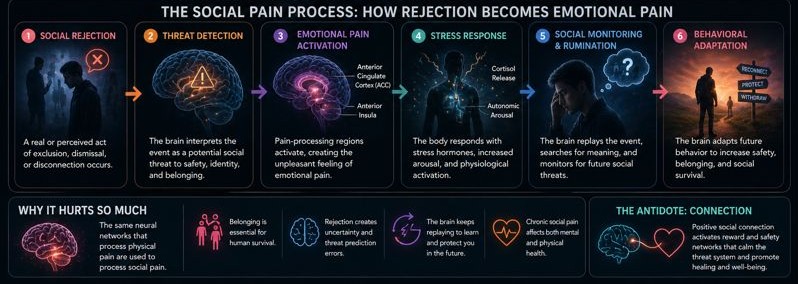
Social rejection
→ Threat detection
→ Emotional pain network activation
→ Stress response
→ Social monitoring and rumination
→ Behavioral adaptation
Each stage reinforces the next,increasing the psychological impact of exclusion and shaping future social behavior.
The intensity of social pain reveals something important about human cognition.
Belonging is not merely a preference layered on top of survival.
For the social brain,belonging became part of survival itself.
As a result,the brain allocates significant emotional and attentional resources toward maintaining social connection and detecting threats to it.
This makes rejection psychologically powerful even in modern environments where immediate physical survival may no longer depend directly on group inclusion.
Research suggests that rejection can alter behavior in multiple directions depending on context and interpretation.
Some individuals become more socially attentive and motivated to reconnect after exclusion,while others may withdraw defensively in order to avoid further pain.
The brain attempts to adapt to perceived social threat,but the form that adaptation takes may vary depending on previous experiences,emotional regulation,and perceived control over the situation.
Social rejection hurts because the brain does not treat social connection as psychologically optional.
It treats it as biologically important.
The emotional pain produced by exclusion reflects systems shaped by evolutionary pressures in which belonging increased safety and isolation increased vulnerability.
What feels like emotional suffering is therefore not “imaginary” pain in the dismissive sense often implied.
It is a real neural response to perceived social threat.
And for the social brain,that threat matters deeply.