
MindCode
JOURNAL
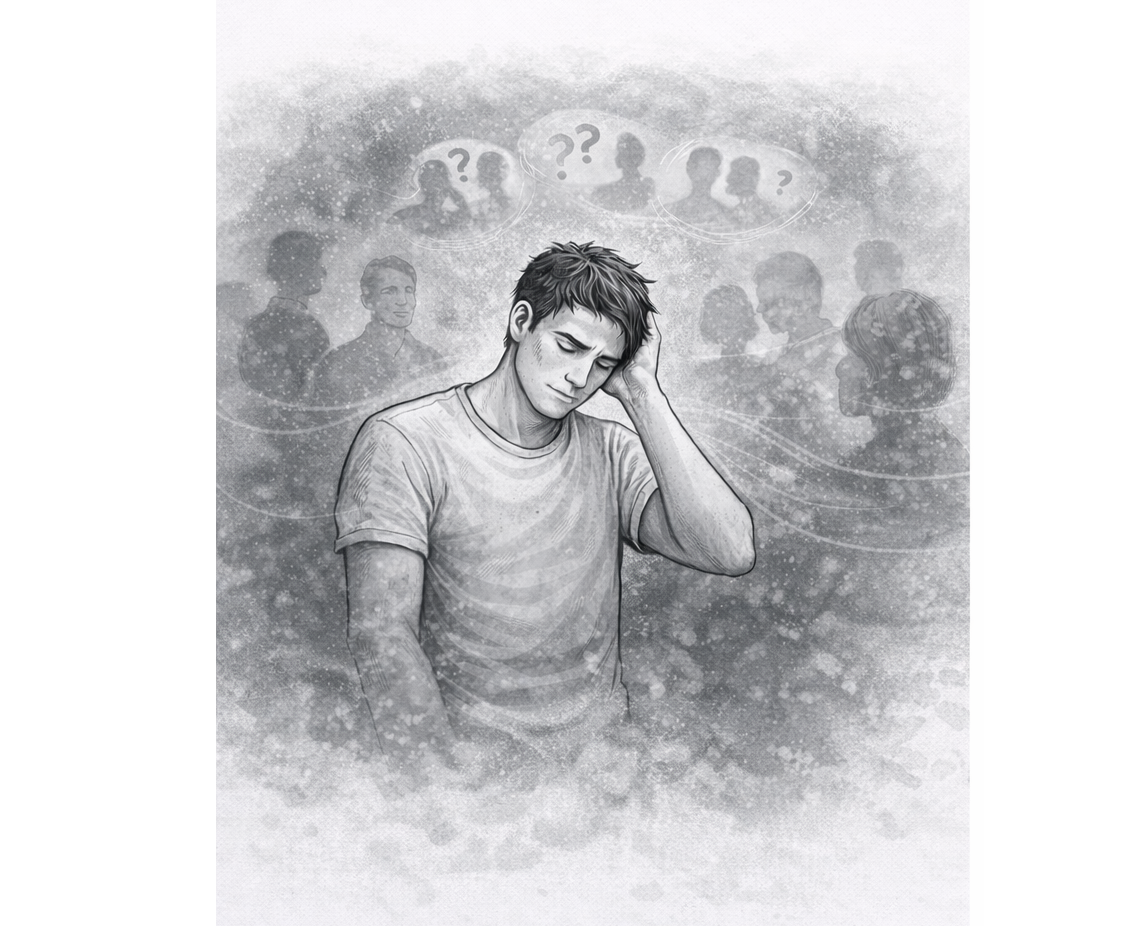
There is a subtle but significant shift that can occur in the way you experience yourself, and what makes it particularly difficult to recognize is that it does not feel like a clear change in identity, but rather like a gradual change in perspective that unfolds almost imperceptibly over time.
At some point, without a distinct transition or a single defining moment, you stop experiencing yourself directly and begin to experience yourself as if you are being observed, as if there is an external lens through which your thoughts, your behaviors, and even your emotional responses are being continuously evaluated.
Your attention is no longer oriented solely toward what you feel or think in the moment, but increasingly toward how these internal experiences might appear to someone else, how they might be interpreted, and what they might suggest about you as a person, which introduces a second layer of awareness that begins to coexist with, and sometimes override, your immediate experience.
And once this shift takes place, it becomes progressively more difficult to return to a more direct, unfiltered sense of self, because your internal experience is no longer self-contained.
You are not only living your experience.
You are also interpreting it from the outside.
Human self-awareness is fundamentally social in nature, and the ability to consider how we are perceived by others is not inherently problematic, but rather a necessary cognitive function that allows us to navigate complex social environments, adapt our behavior, and maintain meaningful interactions.
However, this capacity also introduces a second perspective that exists alongside direct experience, creating a dual-layered system in which there is both the experience of being yourself and the constructed experience of how you believe you are being seen.
Under typical conditions, these two layers remain in relative balance, allowing you to engage with others while still maintaining a stable internal reference point, but this balance can shift when attention becomes disproportionately focused on the external perspective.
When that happens, the imagined viewpoint of others begins to dominate the way you interpret your own behavior, and the internal perspective becomes less reliable, less immediate, and more dependent on external validation—even if that validation is only inferred rather than directly received.
Social interaction naturally involves a certain degree of self-monitoring, but this monitoring can intensify when the mind begins to prioritize evaluation over participation, leading to a state in which you are no longer simply engaging with the interaction, but simultaneously analyzing it as it unfolds.
Instead of responding spontaneously, attention becomes divided between what is happening and how it is being perceived, creating a layer of cognitive interference that alters the quality of the interaction itself.
You begin to ask, implicitly or explicitly, questions such as whether your response was appropriate, whether your tone conveyed the intended meaning, or whether your presence is being interpreted in a particular way, and these questions begin to shape your behavior in real time.
As a result, what was previously fluid becomes controlled, what was previously intuitive becomes deliberate, and the interaction gradually shifts from something that is experienced to something that is managed.
A significant portion of self-concept is formed through interaction with others, but when this process becomes overly internalized, self-perception begins to rely less on direct experience and more on constructed interpretations of how one is perceived.
You begin to develop an internal model of external perception, which is continuously updated based on subtle cues, incomplete information, and inferred meaning, rather than on explicit feedback or confirmed understanding.
The critical issue here is that this model is inherently indirect, as it is not based on direct access to others’ thoughts, but on your own interpretation of what those thoughts might be, which introduces a high degree of uncertainty into the process.
Despite this uncertainty, the model can become increasingly influential over time, shaping not only how you interpret past interactions, but also how you anticipate and approach future ones, eventually becoming integrated into your sense of self in a way that feels stable, even if it is not entirely accurate.
What makes this process particularly powerful is the way in which imagined perception is treated by the mind as if it were equivalent to actual perception, meaning that the emotional and cognitive responses it generates are often indistinguishable from those that would arise from direct feedback.
If you believe that you appeared uncertain, distant, or ineffective, the emotional response will typically follow that belief, regardless of whether it reflects reality, because the mind does not differentiate strongly between inferred and confirmed evaluation in the moment.
This creates a feedback loop in which behavior is interpreted, interpretation shapes self-image, and self-image influences subsequent behavior, reinforcing the original assumptions even in the absence of external confirmation.
Over time, this loop can become self-sustaining, as each iteration strengthens the perceived connection between how you think you are seen and who you believe yourself to be.
As this pattern becomes more established, direct experience begins to recede, not because it disappears, but because it is continuously filtered through a layer of interpretation that alters its immediacy.
Instead of simply feeling something as it arises, you begin to evaluate how that feeling might be perceived, and instead of expressing something naturally, you monitor how it is being received, which creates a distance between you and your own experience.
This distance is subtle, but it has significant implications, because it changes the way you relate to yourself, shifting from participation to observation.
You are no longer fully inside the experience.
You are watching it happen.
Maintaining this dual awareness requires a considerable amount of cognitive effort, as you are not only processing your own internal state, but also simulating the perspective of others, generating interpretations, and adjusting your behavior accordingly.
This creates a continuous cognitive load that operates in the background of social interaction, often without being explicitly noticed, but with a cumulative effect that becomes apparent over time.
Even simple interactions can feel effortful, not because of their content, but because of the additional layer of monitoring and interpretation that accompanies them.
As a result, mental fatigue develops not from the interaction itself, but from the ongoing requirement to process multiple perspectives simultaneously.
One of the reasons this pattern persists is that it produces a strong sense of accuracy, as the interpretations generated by the mind often feel coherent, plausible, and internally consistent, even when they are based on incomplete or biased information.
The conclusions seem reasonable, and because they align with prior expectations or concerns, they are rarely questioned in the moment.
However, the underlying assumption—that you can accurately infer how you are perceived in real time—is not as stable as it appears, as social perception is complex, context-dependent, and often ambiguous.
What you interpret as a definitive evaluation may in reality be uncertain, neutral, or entirely different from what you imagine, but because the interpretation feels immediate and convincing, it is treated as reliable.
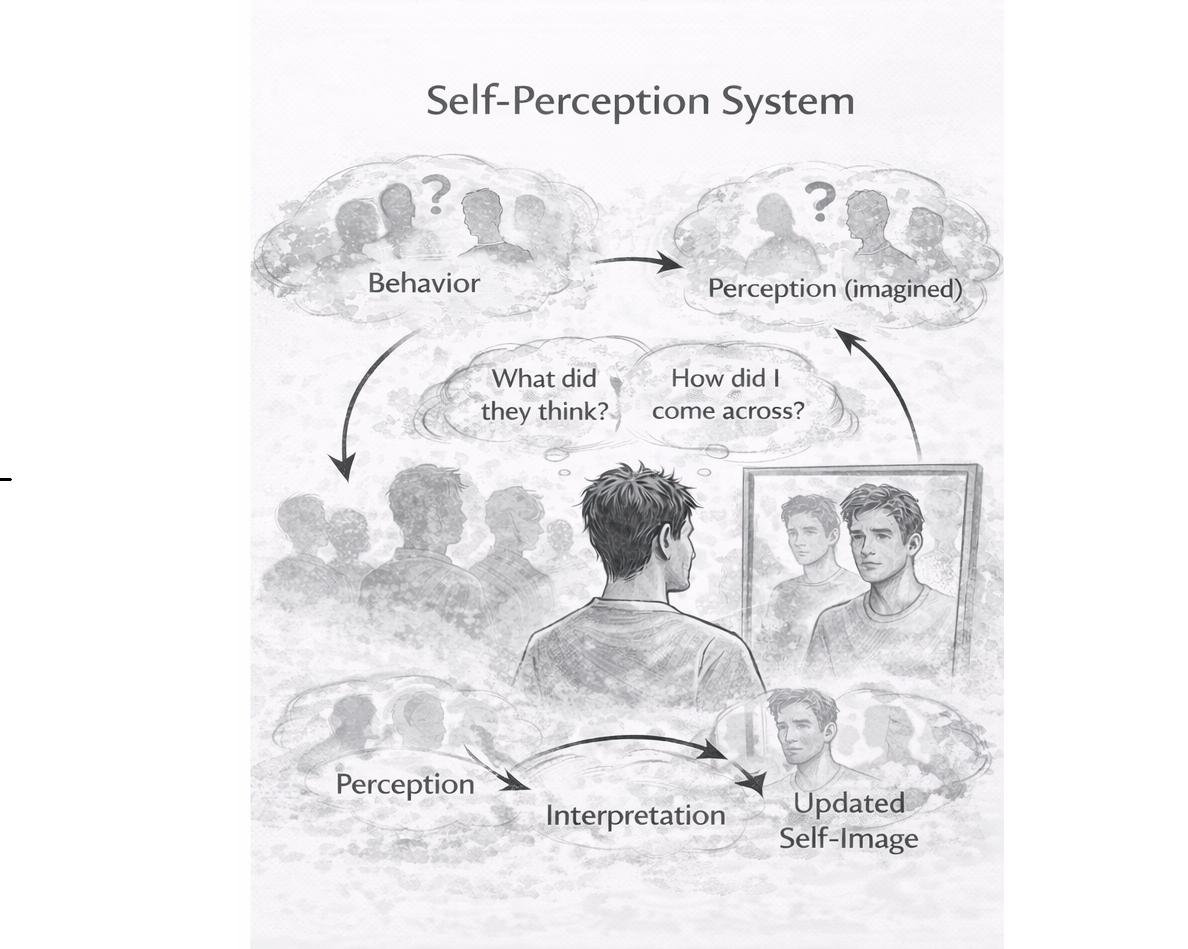
This process can be understood as a system in which each stage reinforces the next, creating a cycle that becomes increasingly difficult to interrupt once it is established.
You act, you imagine how that action is perceived, you interpret that imagined perception, and then you update your self-image based on that interpretation, which then influences how you act in the future.
Each iteration strengthens the connection between imagined perception and self-definition, making it more likely that future interactions will be filtered through the same interpretive framework, even in the absence of new information.
Over time, this loop becomes the default way of processing social experience.
As this pattern continues, identity can become less internally grounded and more externally referenced, meaning that your sense of self is increasingly shaped by how you believe you are perceived, rather than by how you directly experience yourself.
This does not necessarily mean that internal identity disappears, but rather that it becomes more dependent on external input, even when that input is inferred rather than observed.
Because the perceived evaluation is not stable or fully accessible, the resulting self-image can fluctuate, leading to a sense of inconsistency or uncertainty about who you are in different contexts.
This instability is not caused by the absence of identity, but by the variability of the reference point used to construct it.
It may be more accurate to understand this pattern not simply as concern about others’ opinions, but as a shift in the source of self-perception, where identity is increasingly constructed through simulated external perspectives rather than direct internal experience.
This distinction is important because it clarifies what the process is actually doing.
You are not responding to others directly.
You are responding to an internal model of others that you have constructed, and then using that model to define yourself.
The point at which this pattern can begin to change is not the elimination of social awareness, but the rebalancing of attention between internal experience and external interpretation.
Instead of prioritizing imagined perception, attention can gradually return to direct experience, not by ignoring how others might perceive you, but by recognizing that this perception is not fully accessible in the way the mind assumes.
A useful question at this stage is:
“Am I experiencing myself, or interpreting how I am being experienced?”
This question creates a separation between the two processes, making it possible to notice when one begins to dominate the other.
Seeing yourself through other people’s eyes is not inherently problematic, and in many contexts, it is a necessary part of social functioning, but it becomes limiting when that perspective becomes the primary way through which you understand yourself.
When imagined perception replaces direct experience rather than complementing it, your sense of self becomes dependent on something that is not fully accessible or stable.
At that point, you are no longer responding to what is happening.
You are responding to what you believe is happening.
And it is within that gap that distortion, fatigue, and uncertainty begin to emerge.
Related reading: Feeling Mentally Drained Without Doing Anything